For organisations on EU funded research and innovation projects
Every month on your EU projects, recorded once and costed by the rules
People record their hours per work package once a month, on the computer or in the phone app, and the right person approves them. EU Loom then works out the day equivalents, the daily rate and the personnel cost.
Coordinating a consortium? See EU Loom Reporting
Follow 96 hours from the timesheet to the cost
In September one researcher recorded 96 hours on one work package. These are the real screens those hours pass through.
-
Record
One line per work package
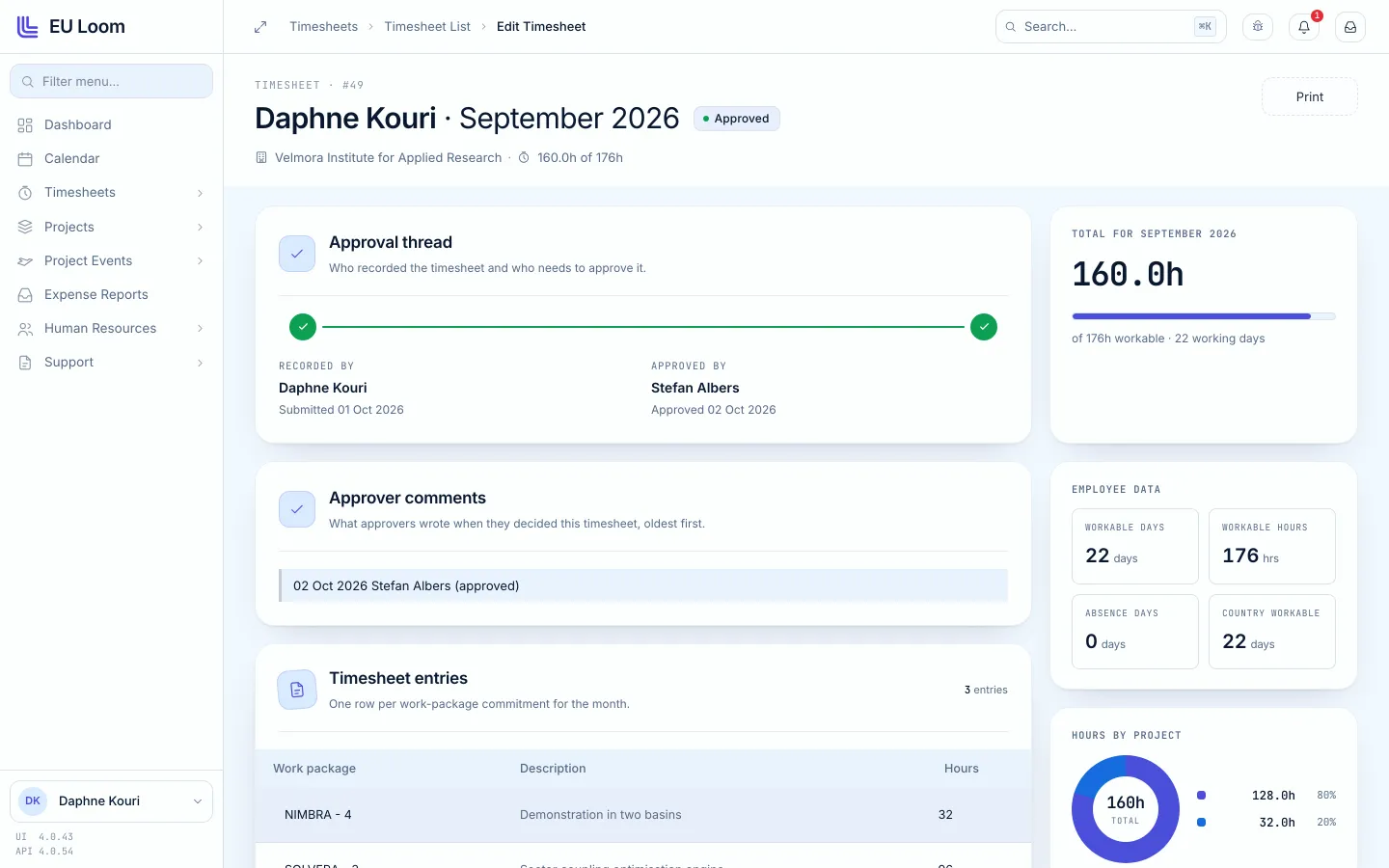
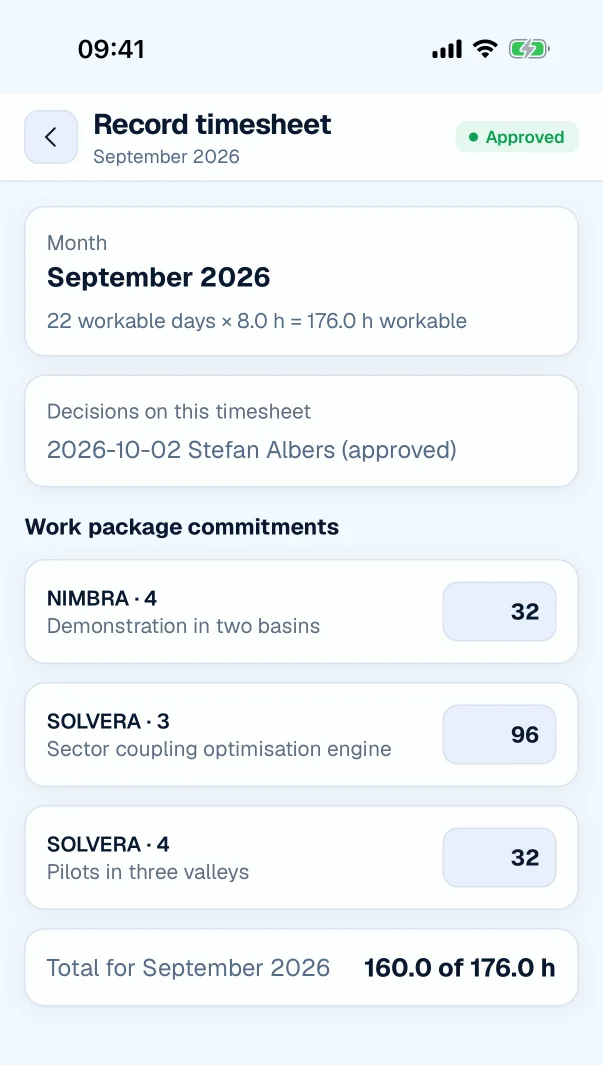
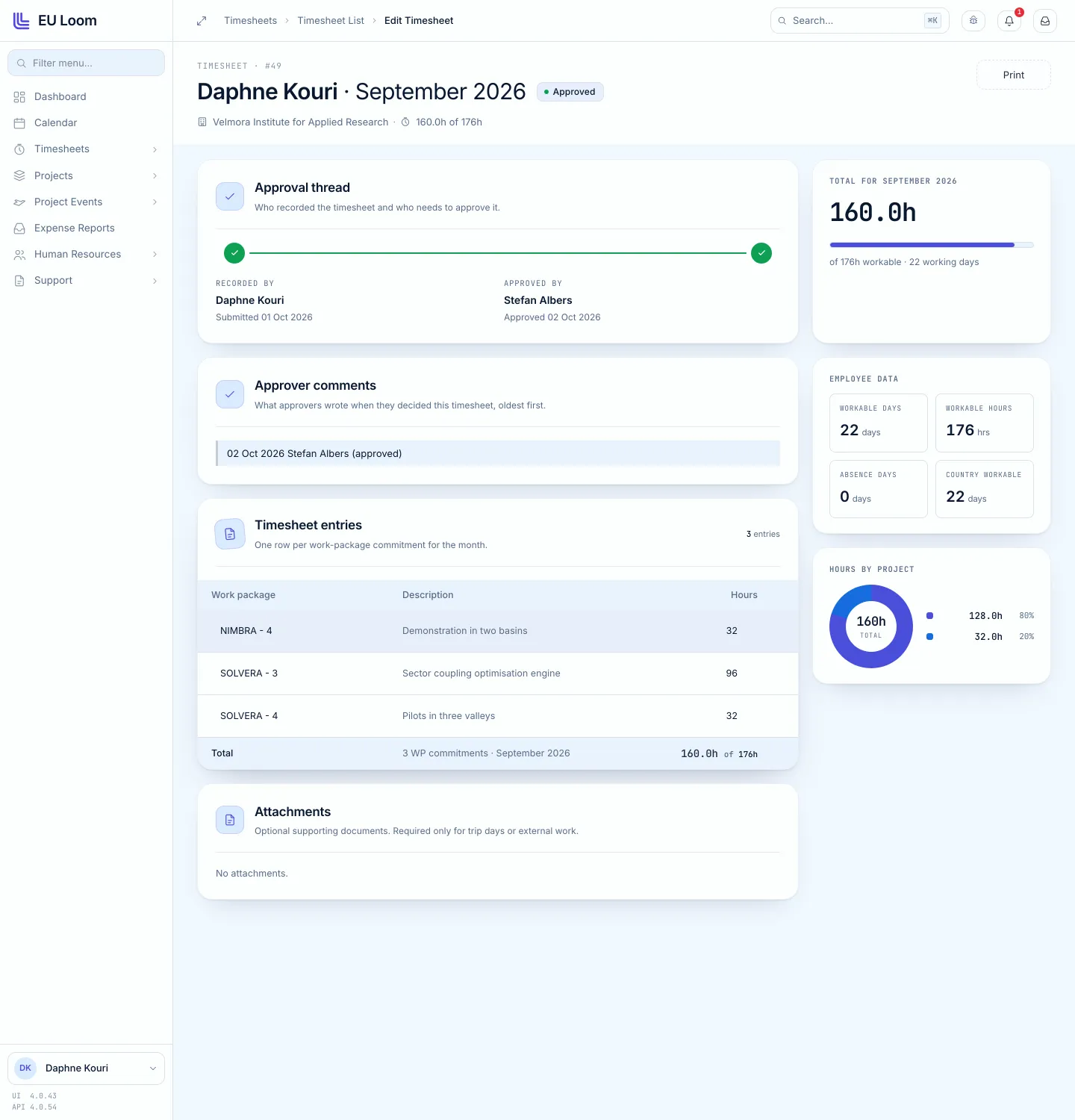
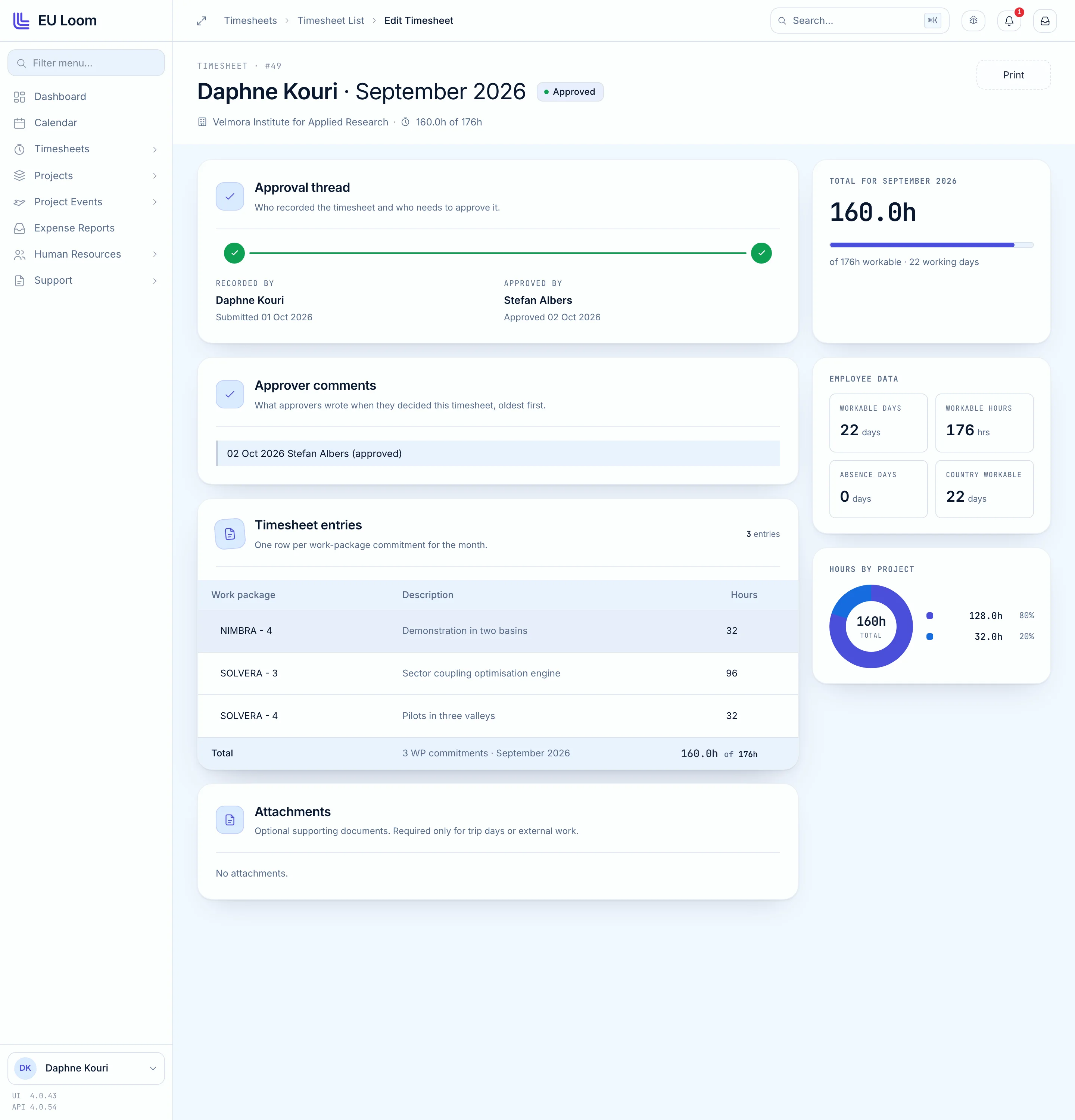
Daphne records September in one timesheet: a line for each work package and the hours for the month. There is no daily grid to fill in, and next month can start from a copy of this one.
96 h on SOLVERA, work package 3 -
Limit
The month already has its hours
EU Loom works out the hours available in the month from each person's contract, approved leave and the national public holidays. For Daphne's September that is 176 hours. A timesheet above the limit is refused.
96 h inside a month of 176 workable hours -
Approve
The right person approves
Every person has an ordered list of approvers. Stefan is first on Daphne's list and approved her month the day after she submitted it. Nobody approves their own timesheet.
96 h approved by Stefan Albers on 2 October -
Pass on
Or the next one does
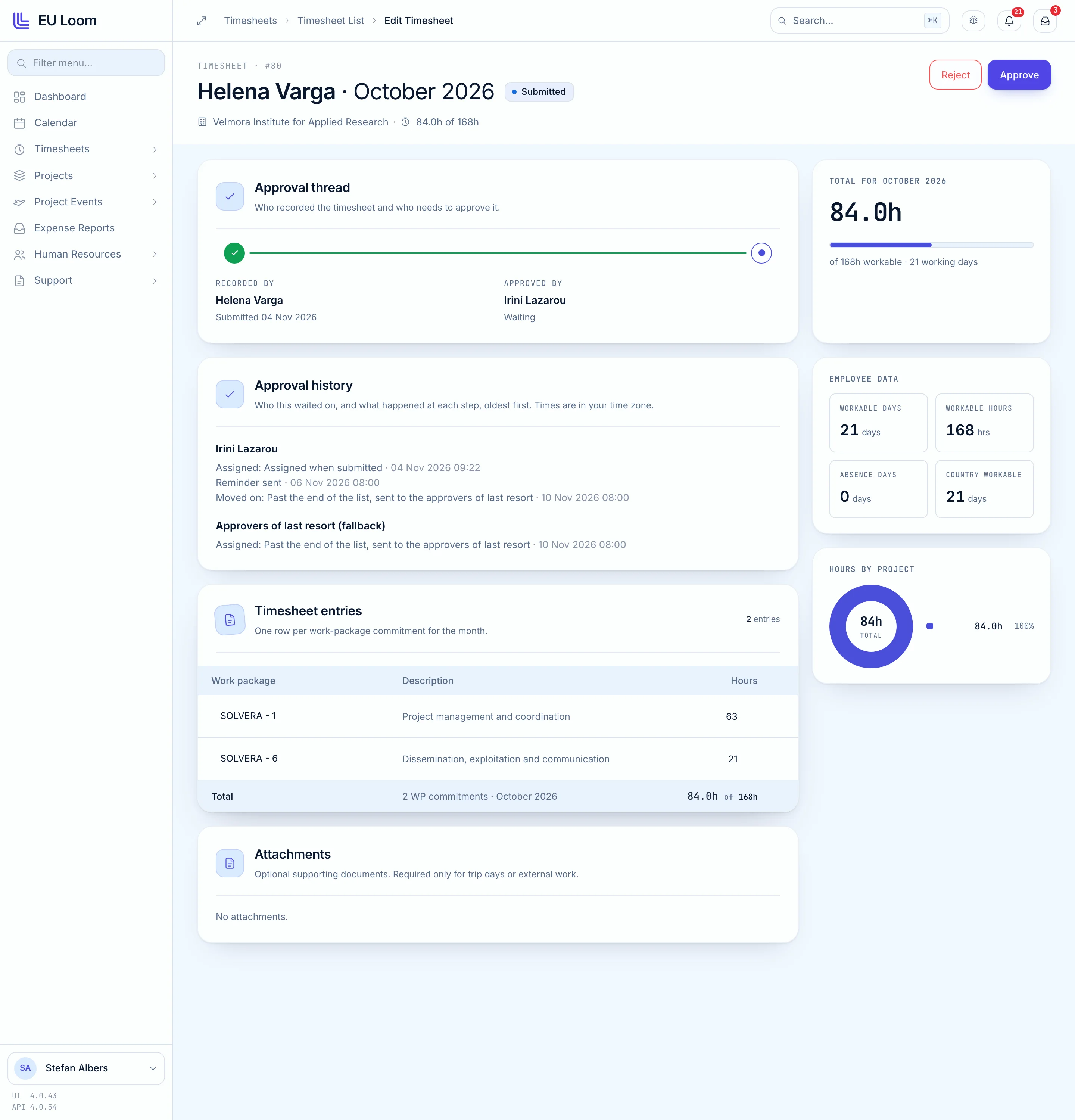
When an approver does not act, EU Loom sends a reminder and then passes the timesheet to the next name on the list. This is a colleague's October timesheet, where exactly that happened.
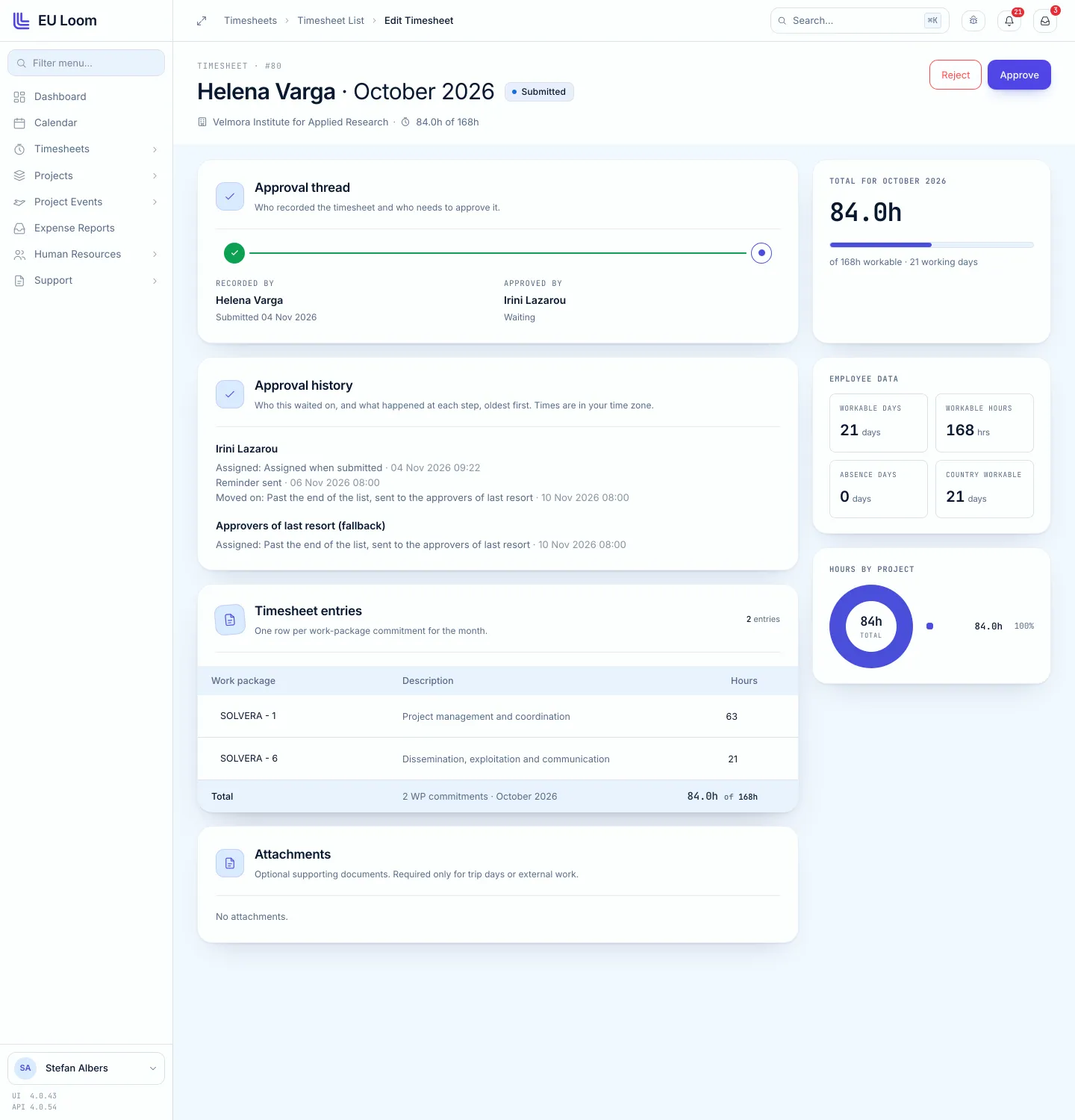
Another timesheet: reminder on 6 November, passed on on 10 November -
Cost
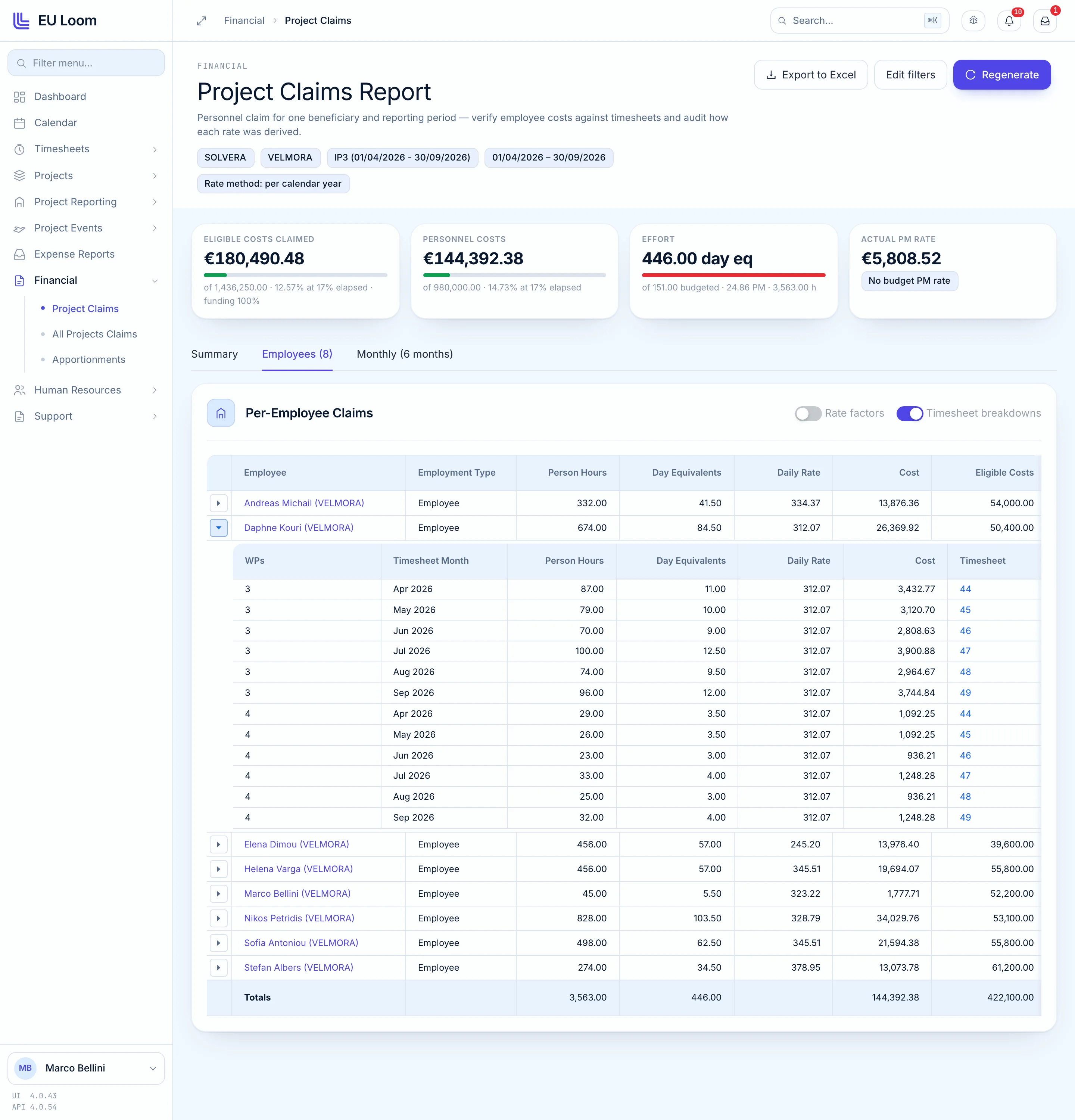
96 hours become €3,744.84
Every night EU Loom calculates personnel costs from salaries, contracts and approved timesheets. Daphne's 96 hours become 12 day equivalents, priced at her daily rate. The row links back to timesheet 49, the one you have just followed.
- Day equivalents from the hours recorded, rounded to the nearest half day.
- The daily rate under the Horizon Europe rules, from actual costs, per reporting period or per calendar year, counting only the months that fall inside the period.
- The 215 day limit checked across all of a person's projects, lump sum projects included.
Checked against our own books. For one reporting period of one of our own projects, EU Loom's calculation and our accountant's workbook differed by less than €0.03 across €176,641 of personnel costs. This was an internal comparison, not an audit.
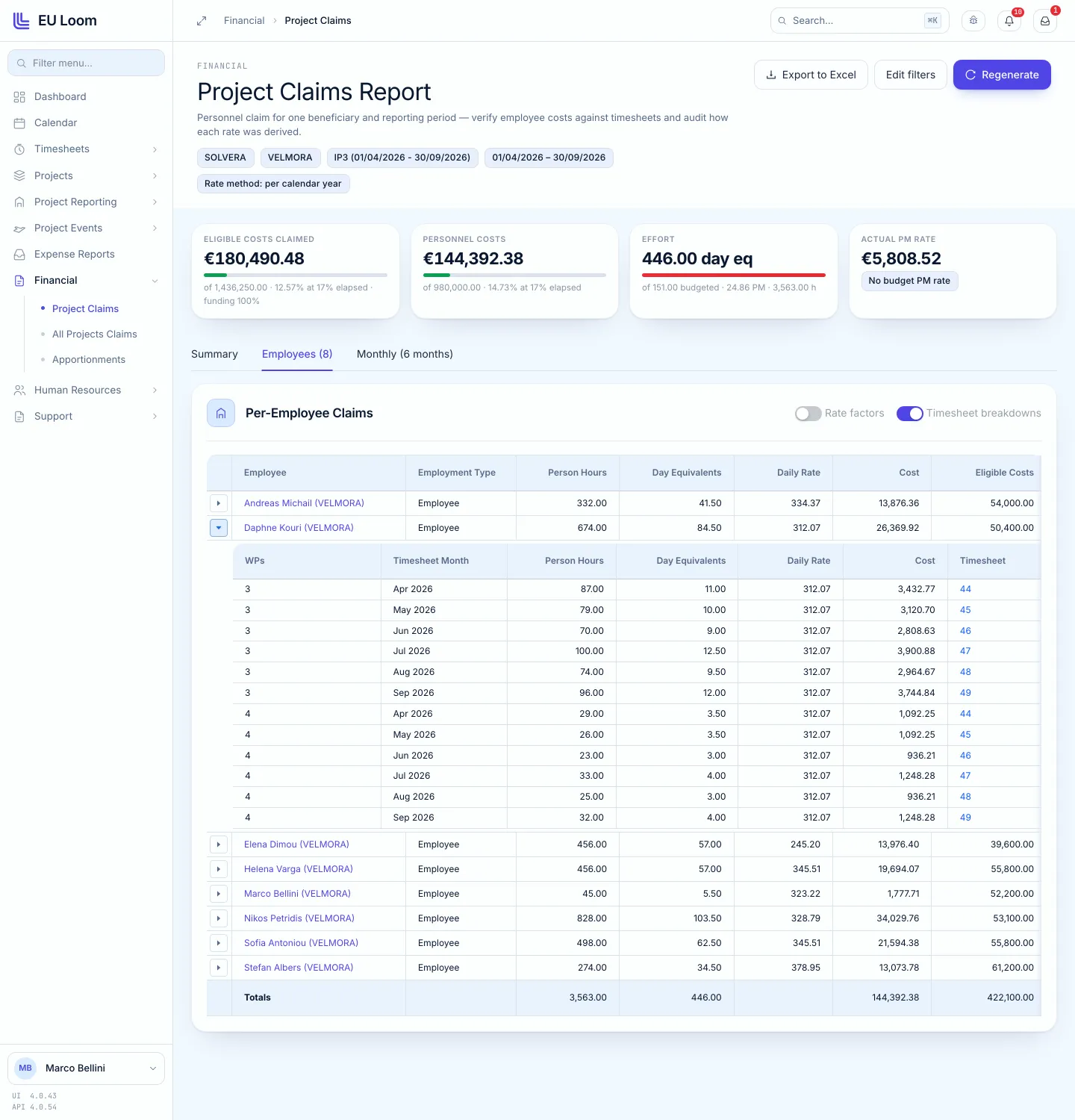
96 h → 12.0 day equivalents × €312.07 = €3,744.84
Leave and travel end up where they belong
Leave, trips and expenses are requests with their own approvals. Leave ends up in the month's hours, and travel in the project's costs.
-
Leave
Leave is a request, with its own approvers
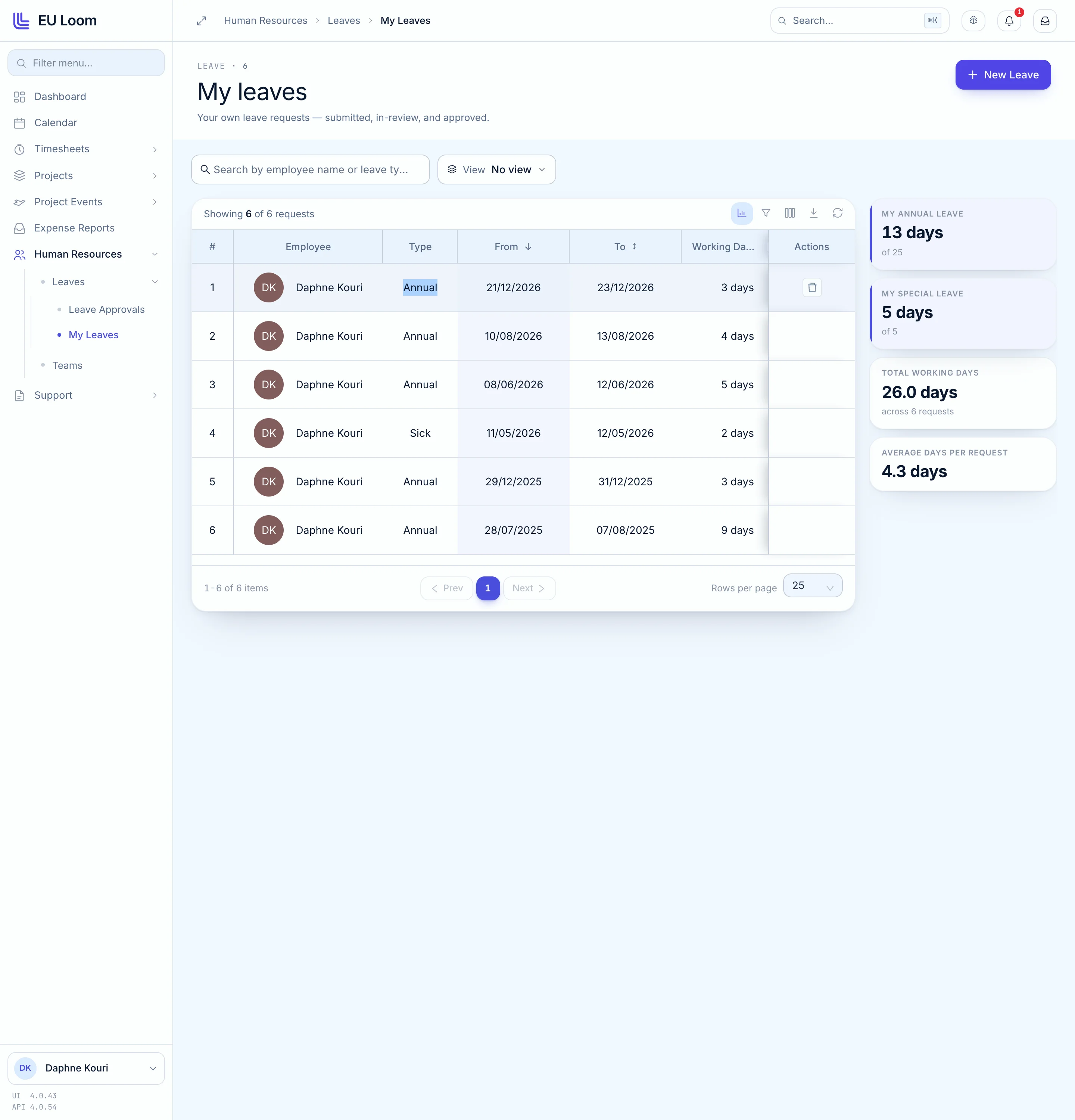
Daphne asks for four days in August. Leave has its own ordered list of approvers, separate from the timesheet list, and the request shows what it takes from her allowance.
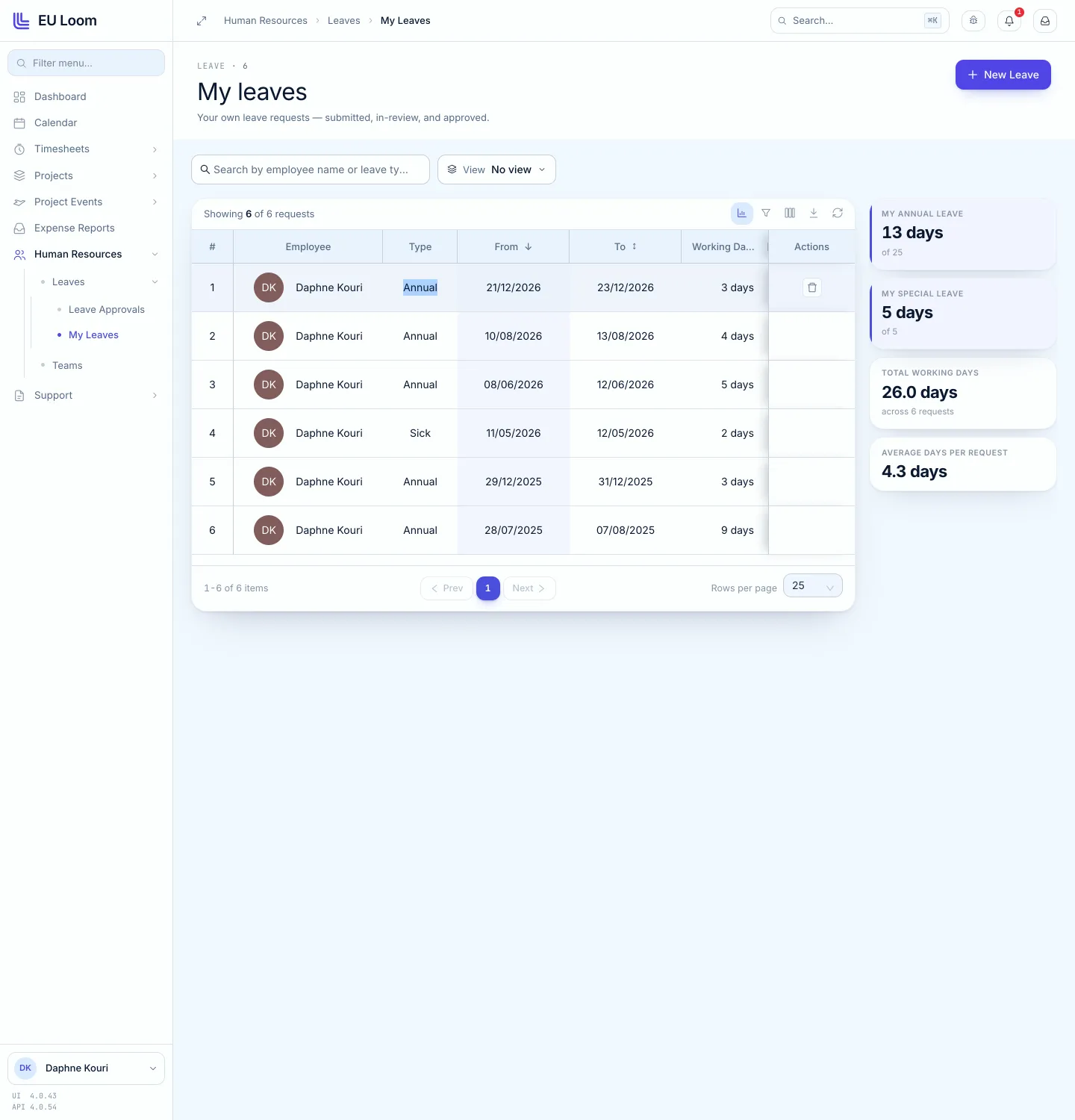
4 days of annual leave, 10 to 13 August -
Month
Approved leave lowers the month
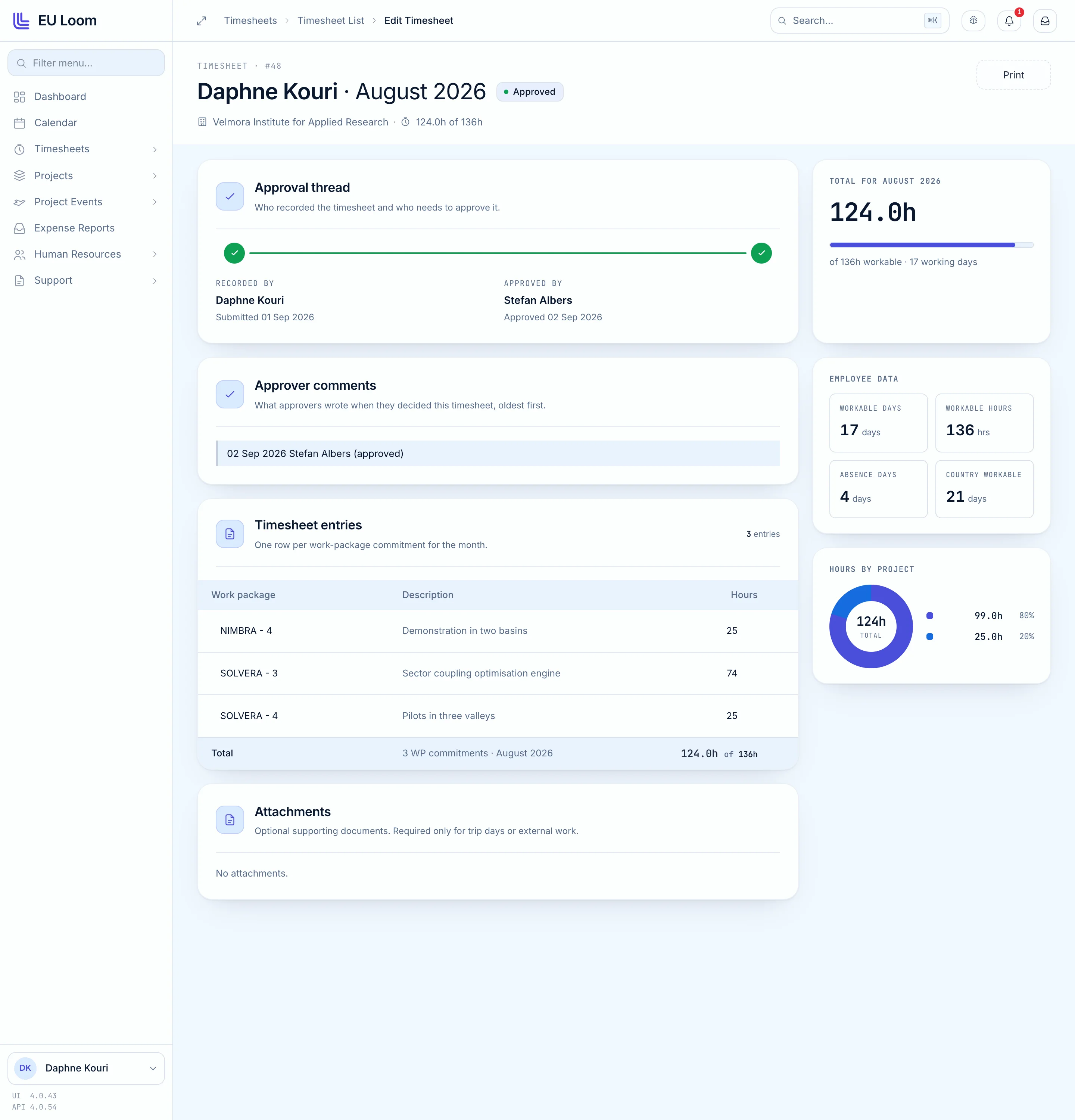
Nobody subtracts the leave by hand. Her August timesheet already allows 136 hours where a full month would allow 168, and it refuses more.
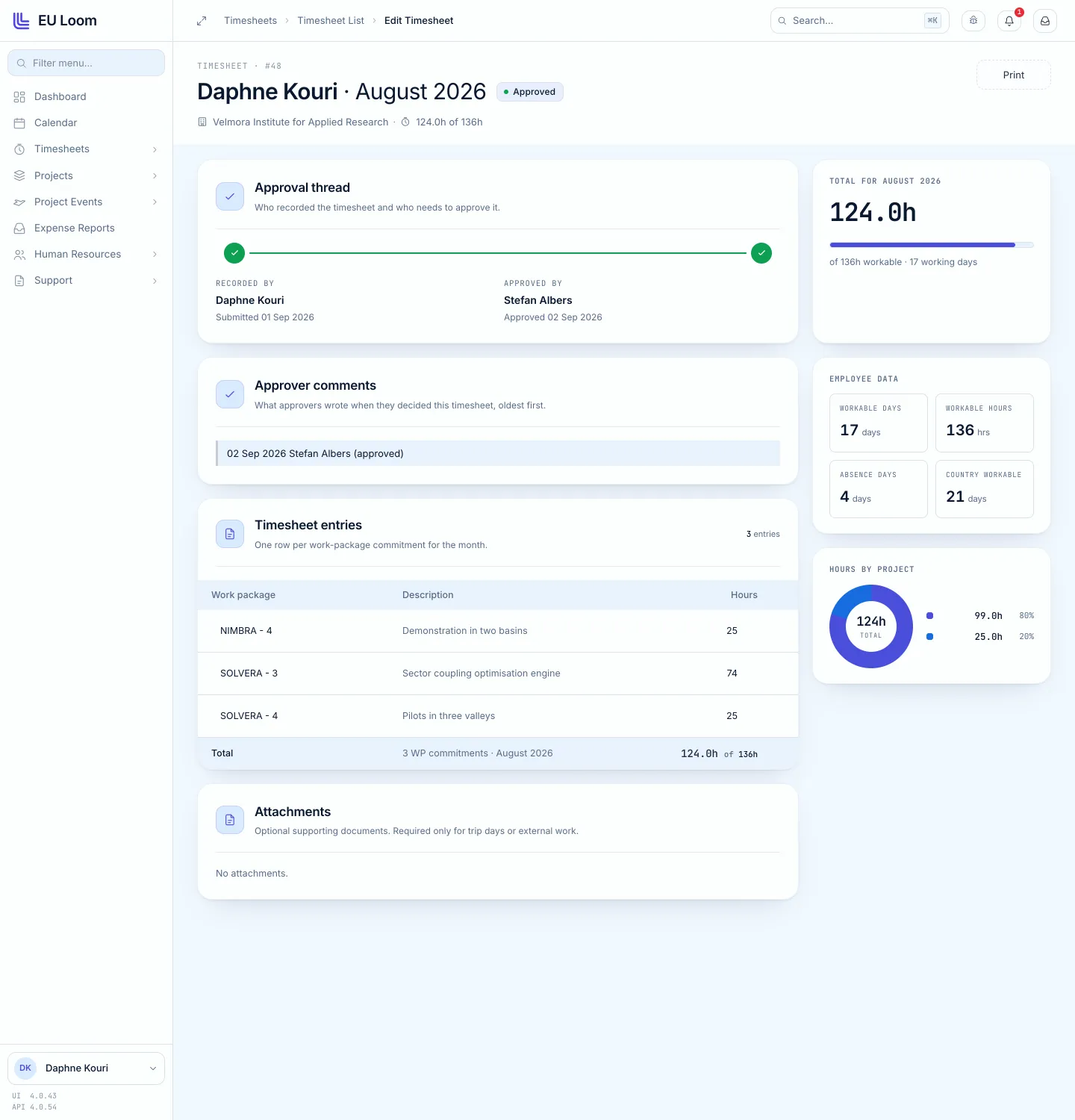
21 working days − 4 days of leave = 17 days, 136 workable hours -
Trip
A project meeting leads to a trip
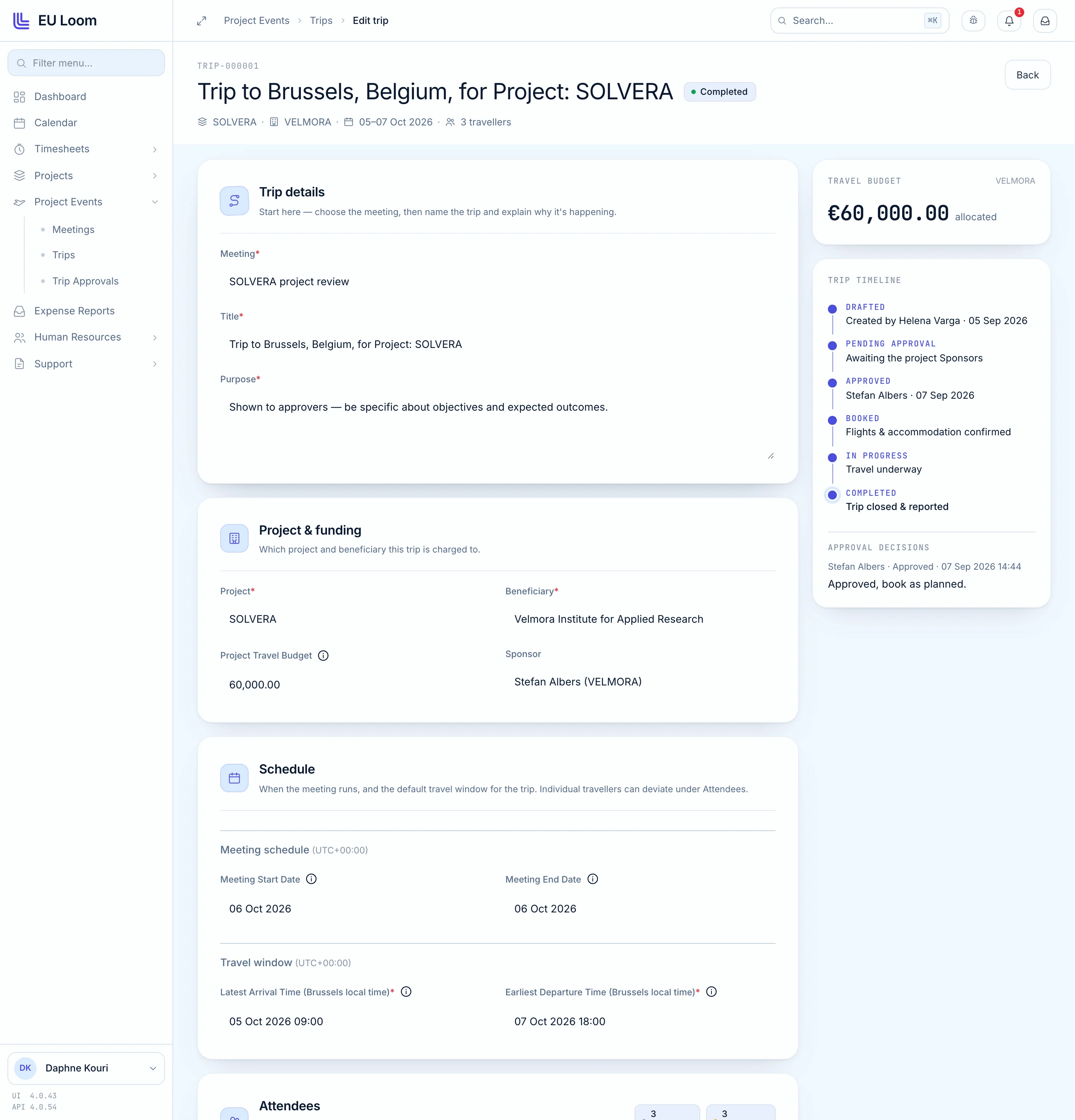
The coordinator adds the SOLVERA project review in Brussels, and the people attending become travellers on one trip. The project sponsor approves it before anything is booked.
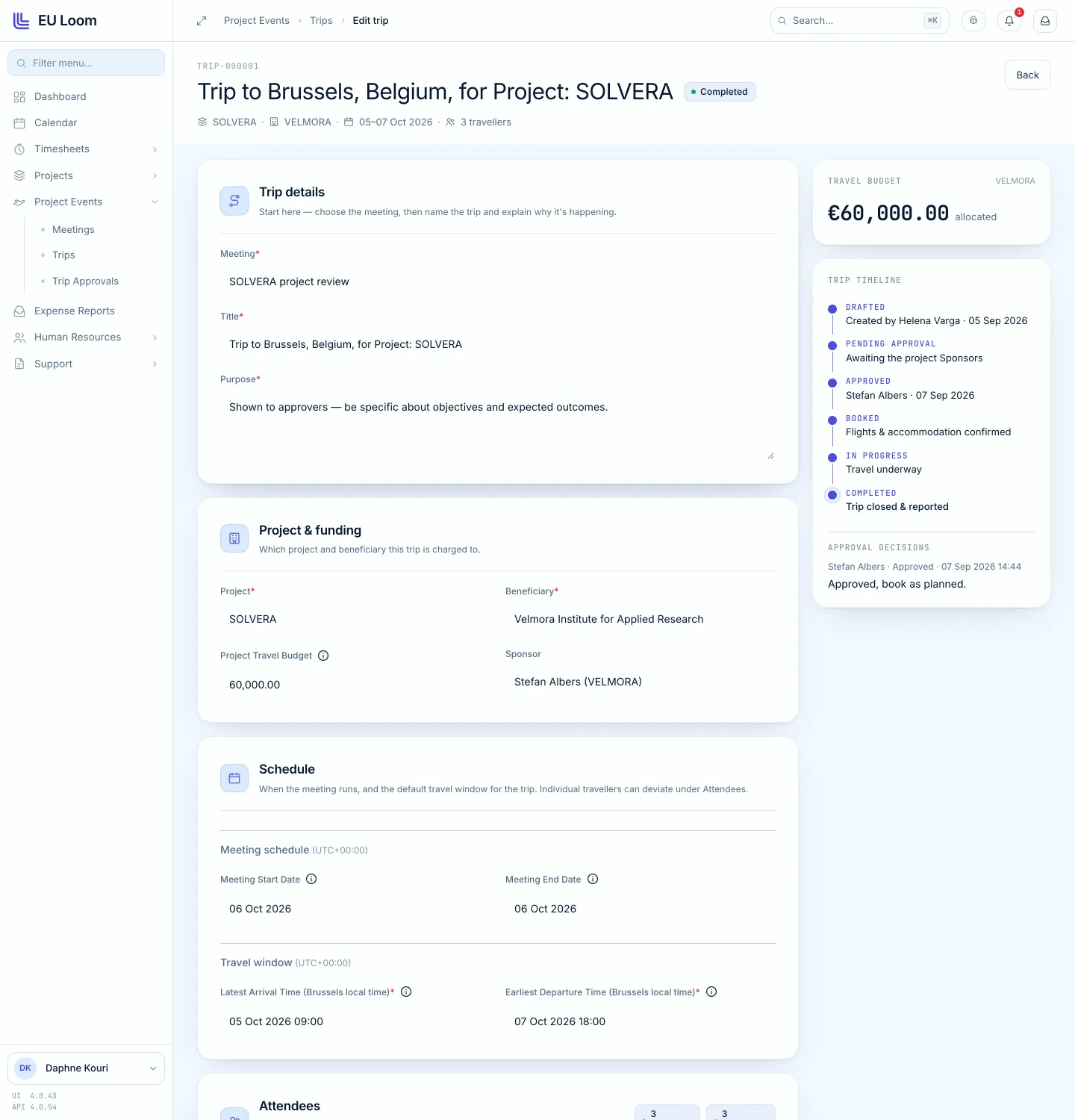
Project review in Brussels: trip approved on 7 September -
Expenses
Each traveller files what they paid
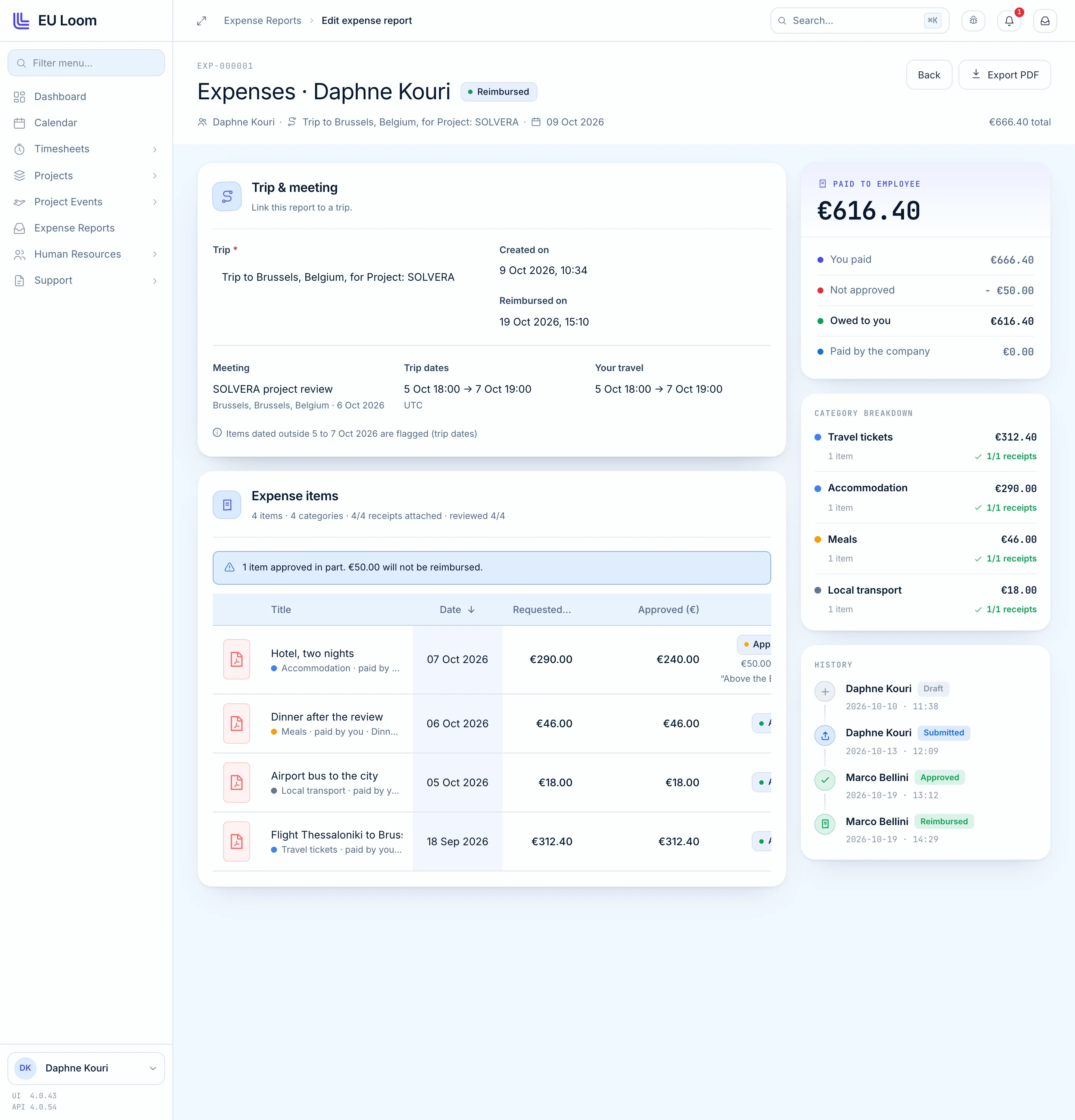
Daphne files her hotel, a dinner, the airport bus and her flight against that trip, on the web or by photographing receipts in the app. Items dated outside the trip are flagged.
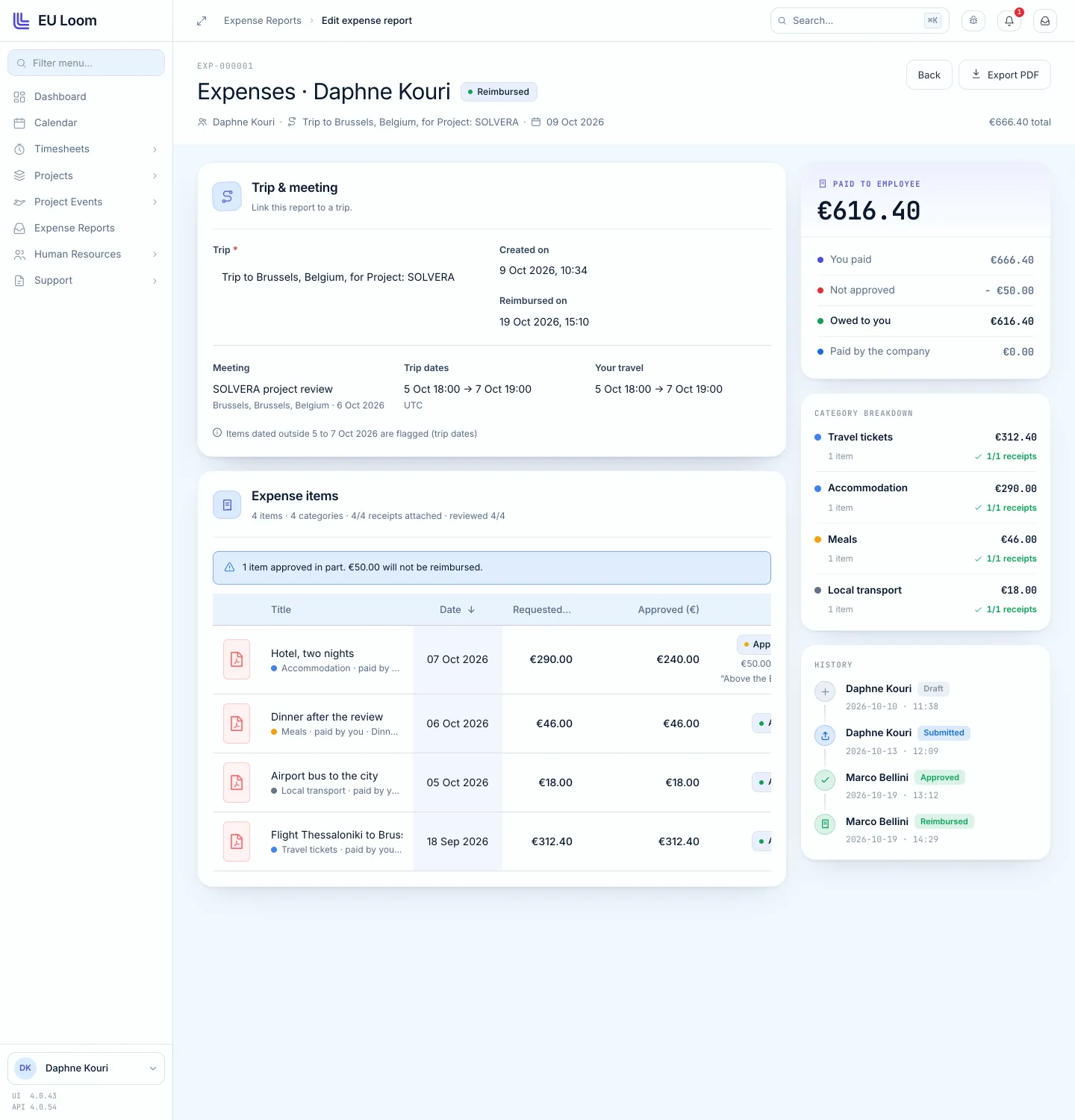
€666.40 requested in four items, each with its receipt -
Decide
Finance decides item by item
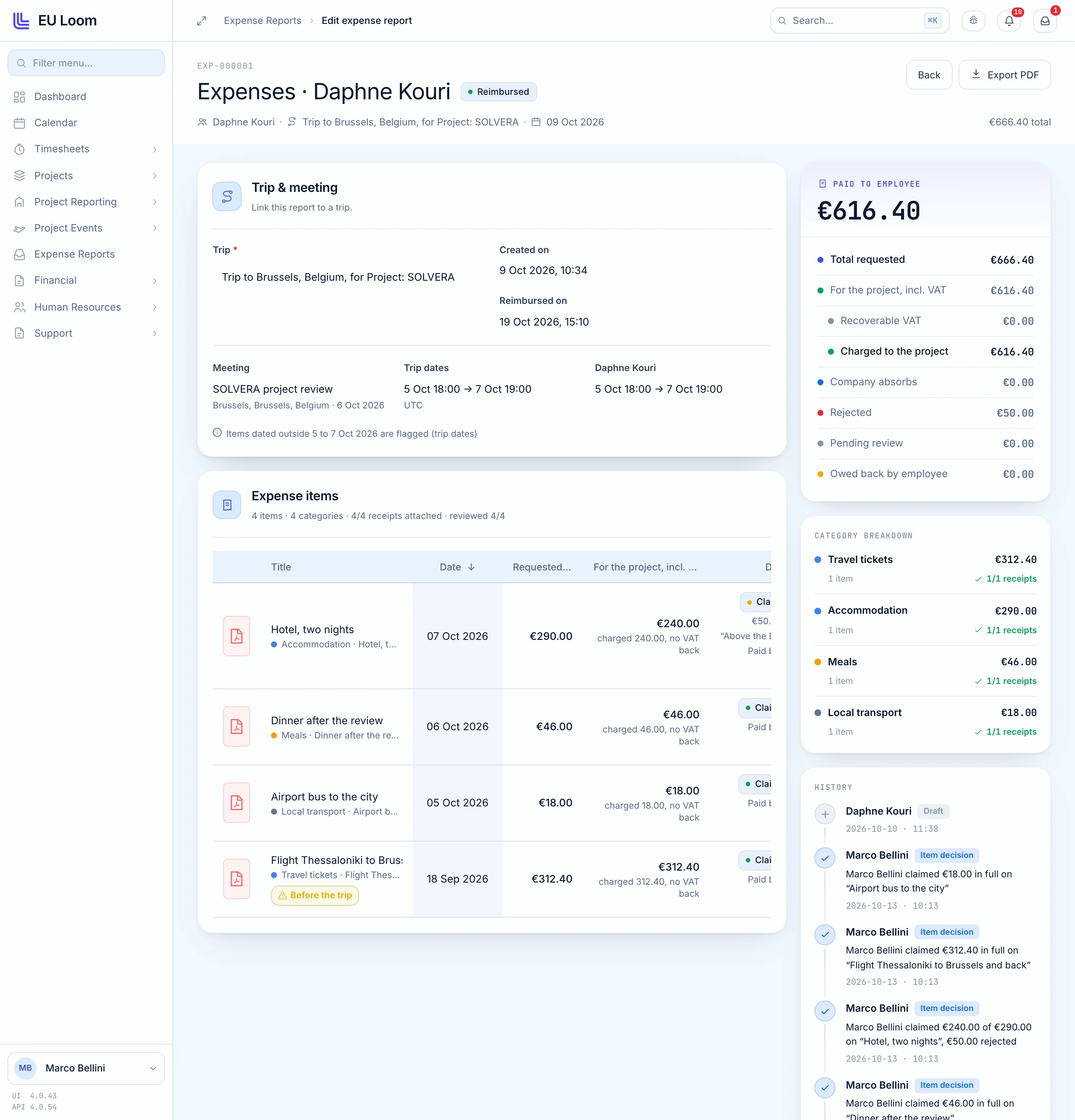
The finance officer approves three items in full and the hotel in part, with the reason shown to Daphne. Recoverable VAT is kept apart, and what remains is charged to the project and reimbursed.
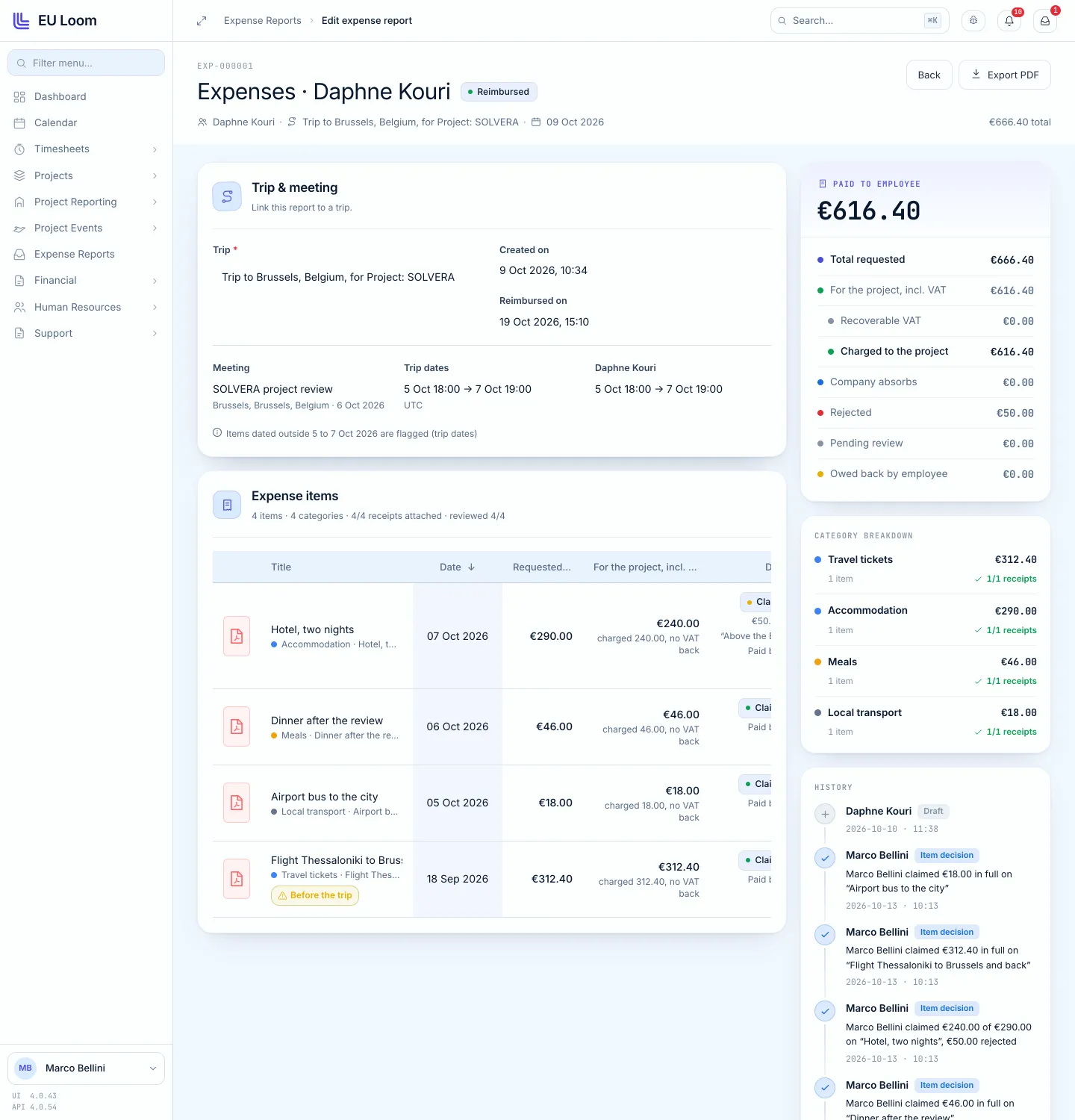
€666.40 − €50.00 not approved = €616.40 charged to the project
Built by people who report on EU projects themselves
Today five separate companies record their month on the EU Loom Platform. EU Loom Reporting is trusted by coordinators to manage seven consortium projects, with between 7 and 32 participants each.
Konnecta has taken part in 17 EU funded projects since 2020. We built EU Loom for our own monthly timesheets and cost statements, and we run our own projects on it.
If your new grants are lump sum
People record their month in the same way, and their lump sum hours count towards each person's 215 day limit.
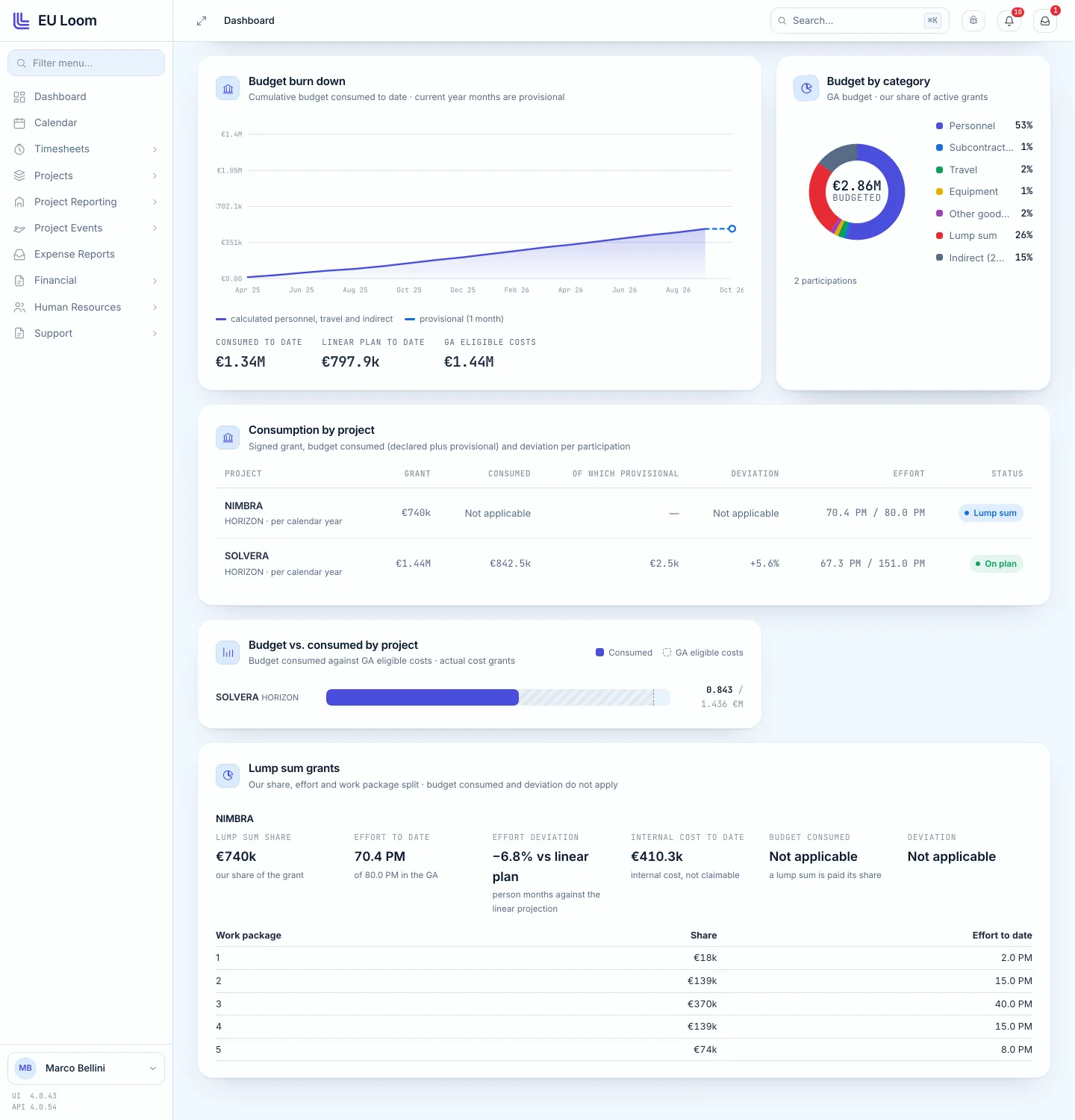
For your finance team, the Platform shows each lump sum grant with your share, the effort recorded against the plan, and your internal personnel cost to date, which is not claimed. Each work package is listed with its share and the effort recorded on it.
EU Loom Reporting · a separate product
Coordinating a consortium?
EU Loom Reporting collects every partner's cost statement for a period in one place. A partner cannot submit a figure that deviates beyond the project's limit without a written justification. You approve each statement or return it with a comment, and a period summary shows the consortium side by side.
Partners work in a web browser. Reporting is sold on its own, under one contract with the coordinator.
Ask about ReportingRead the transcript
EU Loom Reporting shows a coordinator every partner's costs, period by period.
Marco coordinates SOLVERA, with four partners.
The project sets how far effort and costs may deviate from the plan.
He opens a period, and every partner gets a draft cost statement and an email.
At ORRIN, Joana receives hers.
She enters her effort and personnel costs, then travel.
Subcontracting, equipment and other goods have their own sections.
Her personnel costs are above the limit, so she explains before she can submit.
Marco is notified.
He reads her explanation and approves the statement.
VEDMARKE is late, so he sends a reminder.
The period summary puts all four partners together.
What needs attention comes first, with each explanation beside it.
Then effort per work package, the use of resources against the budget, and each partner's rate against the grant agreement.
It all exports to Excel.
One period, and Marco knows where every partner stands.
EU Loom Reporting.
Know where your consortium stands.
The project, people and organisations in the video are fictional.
We set it up with you
Before the first month
We set up your organisation, your projects, your people and their approvers together with you.
Beside your spreadsheet
Many finance teams keep their own workbook going for the first period and compare the figures. We did the same.
Your data
EU Loom is hosted in the EU. Each customer has its own application and its own database.
Questions people ask first
What is EU Loom?
EU Loom is software for organisations that take part in EU funded research and innovation projects. People record their hours per work package once a month, the right person approves them, and EU Loom calculates the day equivalents, the daily rate and the personnel cost.
Does EU Loom follow the Horizon Europe rules for personnel costs?
Yes. EU Loom calculates day equivalents from the hours recorded and the daily rate from actual costs, per reporting period or per calendar year. It checks the 215 day limit across all of a person's projects, lump sum projects included.
How often do people record their time?
Once a month. A timesheet has one line for each work package and the hours for the month, and it can start from a copy of the previous month. EU Loom works out the hours the month allows from the contract, approved leave and the national public holidays.
Does EU Loom work for lump sum grants?
Yes. People record their month in the same way. For finance, EU Loom shows each lump sum grant with your share, the effort recorded against the plan and your internal personnel cost to date, which is not claimed.
What is the difference between EU Loom and EU Loom Reporting?
EU Loom, the Platform, is for one organisation and any number of its projects: timesheets, approvals, leave, travel, expenses and personnel costs. EU Loom Reporting is a separate product for the coordinator of a consortium, who collects and reviews every partner's cost statement for a period. Each is sold on its own.
Where is our data kept?
EU Loom is hosted in the EU. Each customer has its own application and its own database.
How is EU Loom priced?
Per user, per month, with setup and support included in the price. Request a demo and we will give you a price for your organisation.
See a month in EU Loom
Tell us a little about your projects. We will show you a month from start to finish, recorded, approved and costed, using fictional data.
EU Loom is priced per user, per month. Setup and support are included in the price.